Student Marine Autonomous Systems Workshop
Project Lead: Dr. Marvin Wright; marvin.wright@ieee.org
IFAC Sponsor: Education Committee
Background and objectives
The IEEE Oceanic Engineering Society (OES) Student Marine Autonomous Systems Workshop (SMRW) was organised to bring together students, academics and industry stakeholders from across the UK and Ireland who are working in marine robotics and autonomous systems. The aim of the workshop was to provide a platform for sharing ongoing work, identifying common interests and creating opportunities for future collaboration. In particular, the event sought to connect students, competition organisers and end-users from industry to encourage discussion around the future needs of the marine robotics sector.
Marine robotics and autonomous systems are becoming increasingly important across a wide range of maritime applications, including renewable energy, offshore operations, fisheries, environmental monitoring and marine conservation. Supporting the development of students and early-career researchers is essential to ensuring that the UK and Ireland continue to contribute to this rapidly developing field.
While countries such as the USA and regions in Asia have developed strong marine robotics communities through established student competitions such as RoboNation’s RoboBoat and RoboSub, similar activities in Europe, including the UK and Ireland, remain more distributed. The workshop was organised to help address this by providing a shared forum where students, researchers and industry representatives could exchange experiences and build connections.
The UK and Ireland have a strong maritime heritage, world-class universities and a significant marine technology sector. By bringing together these communities, the workshop aimed to support future collaboration, improve links between education and industry and help prepare the next generation of engineers and researchers working in marine autonomous systems.
Organisation, venue and support
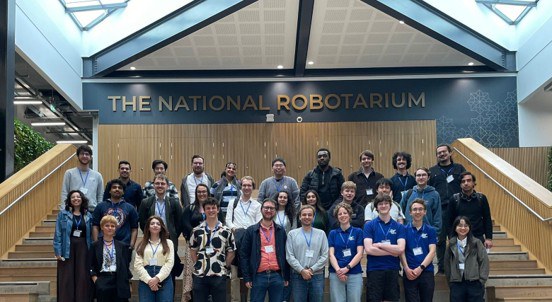
The workshop was led and organised by Marvin Wright, with support from colleagues within the UK and Ireland marine robotics community. The event was hosted at The National Robotarium in Edinburgh, which provided an excellent venue due to its focus on robotics research, innovation and industry engagement.
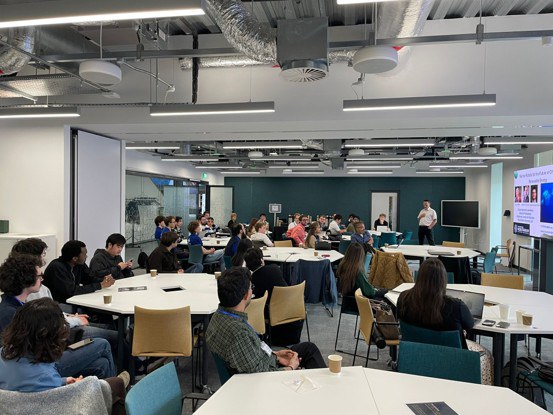
The National Robotarium provided the facilities needed to host technical presentations, poster sessions, networking activities and provided a tour at the end of the workshop to showcase the facilities and ongoing robotics research. The location also helped highlight the connection between academic research and practical robotic applications.
The workshop was supported by several organisations that recognised the importance of developing future talent in marine robotics and autonomous systems. Support was provided by the IEEE Oceanic Engineering Society (OES), the International Federation of Automatic Control (IFAC), the Advanced Research + Invention Agency (ARIA) and Nortek. The support from these organisations enabled the workshop to be delivered and allowed participants from across the UK and Ireland to take part. In particular, the sponsorship funding provided travel support for four of the invited speakers and six student attendees, helping to reduce barriers to participation and ensuring that contributions from across the marine robotics community could be represented. The funding also supported the practical delivery of the event, including catering including lunch, coffee and tea, creating opportunities for informal discussions and networking throughout the day.
Invited speaker talks
A key part of the workshop was a series of invited talks covering a broad range of topics within marine robotics and autonomous systems. The programme demonstrated the diversity of research and applications within the field, including autonomous underwater and surface vehicles, navigation, perception, underwater communication, marine operations, inspection technologies and the transition of research prototypes towards real-world deployment.
The invited speakers represented universities, research organisations and industry from across the UK, highlighting the strength of the national marine robotics community. Contributions included perspectives from the NATO Centre for Maritime Research and Experimentation (CMRE), the Society of Maritime Industries (SMI), the National Oceanography Centre (NOC) and Nortek, providing participants with insight into both research challenges and practical requirements from end-users.
The invited speakers and their presentations were:
|
Speaker |
Affiliation |
Presentation topic |
|
Prof Suphi Erden |
Heriot-Watt University |
Marine Robotics for the Future of Offshore Renewable Energy – Ocean Systems Laboratory at Heriot-Watt University |
|
Nils Coe |
Nortek |
From Pings to Position: Navigating with Sound, Sensors and Science |
|
Dr Nils Morosz |
University of York |
Underwater acoustic networking for maritime autonomous systems |
|
Dr Gabriele Ferri |
NATO Centre for Maritime Research and Experimentation (CMRE) |
From SAUC-E to RAMI: Inspiring the Engineers of Tomorrow Through Robotics Competitions |
|
Emma Johnson |
Society of Maritime Industries (SMI) |
Introduction to SMI and the SMI Marine Autonomy Challenge |
|
Dr Asiya Khan |
University of Plymouth |
Marine Autonomy at the University of Plymouth |
|
Luis Toral |
HPR ROV |
Industry perspective on marine robotics and remotely operated systems |
|
Ahmet Cinar |
Frontier Robotics |
Industry perspective on robotics innovation and deployment |
|
Julia Bonat & Seamus McGinley |
National Oceanography Centre (NOC) |
Introduction to Marine Autonomous Robotic Systems at NOC |
The range of topics demonstrated the interdisciplinary nature of marine robotics, combining robotics, artificial intelligence, sensing, control, hydrodynamics and ocean engineering. The talks provided students and early-career researchers with an opportunity to learn about different research areas, career paths and potential applications of their work.
Poster presentations
The workshop included a poster competition to give students and early-career researchers the opportunity to present their research and discuss their work with other participants. The posters covered a wide range of topics, including autonomous vehicle design, simulation, navigation, control, perception and hydrodynamic modelling.
The poster presenters and their contributions were:
|
Presenter |
Affiliation |
Poster topic |
|
Kaja Gorska, Michael Thompson & Owen Langfield |
University of Strathclyde |
Strathclyde Marine Robotics Society |
|
Alexander Dixon |
University of Strathclyde |
AIRIS |
|
Thi Tran |
Heriot-Watt University |
Underwater Manipulation |
|
V. Anatha Shankar |
Heriot-Watt University |
Dynamic Point Cloud Processing |
|
Romain Tibaudo |
Heriot-Watt University |
Global Loop Closure for 3D Sonar SLAM |
|
Antoine Esman |
Heriot-Watt University |
Active SLAM for Underwater Robotics |
|
Sara Aldhaheri |
University College London |
Towards Autonomous Underwater Manipulation |
|
Paria Rezayan |
Sheffield Hallam University |
From Traceable MARUS Virtual Sea Trials to Online Hydrodynamic Derivative Identification |
The session encouraged informal discussions between presenters, researchers and industry representatives, allowing participants to receive feedback and exchange ideas. It also highlighted the variety of approaches currently being explored within marine autonomous systems.
The winning poster was awarded to Paria Rezayan from Sheffield Hallam University for “From Traceable MARUS Virtual Sea Trials to Online Hydrodynamic Derivative Identification”.
The poster competition helped showcase emerging research and provided recognition for students contributing to the future development of marine robotics.
Attendance and community engagement
The workshop attracted 45 participants from universities, research organisations and industry across the UK and Ireland. Attendees represented a broad range of institutions, including the University of Glasgow, University of Strathclyde, University of Plymouth, Sheffield Hallam University, Heriot-Watt University, Newcastle University, University College London, The University of Edinburgh, York University and Edinburgh Napier University.
The event successfully brought together groups that are often working independently and created opportunities for new connections between students, researchers and industry representatives. Discussions throughout the day highlighted common challenges, potential collaborations and opportunities to better coordinate marine robotics activities across the UK and Ireland.
Overall, the workshop established a foundation for a stronger marine robotics network by connecting universities, industry and professional organisations. It provided students with opportunities to present their work, engage with experts and learn about future opportunities in the sector, while also giving industry and research organisations a platform to engage with the next generation of marine robotics talent.