Developing children’s tridimensional ordinality through control systems and robots
Project Leader: Dr Erivelton Nepomuceno, Maynooth University, Ireland; erivelton.nepomuceno@mu.ie
IFAC Sponsor: Irish NMO
Interest in mathematics is strongly associated with the pursuit of STEM careers. For this reason, many platforms and programs were created to stimulate mathematics education in secondary schools. In contrast, primary schools, where more basic mathematical concepts are taught, do not receive the same level of attention. To address this gap, the project aims to introduce these activities to primary school students, drawing attention to mathematical concepts and control aspects to a younger demographic.
On this gap, two basic objectives were established for the project: to foster numeracy skills by strengthening visuospatial and arithmetical abilities, and to promote STEM engagement in earlier stages of education. The first objective aimed at reducing mathematical anxiety (MA) in children, while the second aimed at using robots as a means to present basic control concepts and attract students for interactive activities. By addressing these objectives, the project aimed to develop evidence-based interventions that educators could use to support students’ learning and confidence in math, while also enhancing community awareness of the importance of control engineering in everyday life.
To accomplish these objectives, a multidisciplinary team was formed. Dr Ariádne Bertolin, with a background in control theory; Matheus Costa, with experience in electronics and embedded systems; Dr Flávia Santos, as the research expert in math cognition; and MSc Samuel Roberts, a contributor from the department of Psychology of UCD, to aid with the proper execution of the activities.
To help develop the children's mathematical literacy, an electronic tool mimicking a number line was conceptualised and built. The device was developed with elements of psychology research in math cognition with the help of Dr Flávia H. Santos and MSc. Samuel C. Roberts. The electronic number line was made interactive by modifying the device's behaviour in response to user inputs on buttons and knobs, which the children would use to answer different questions in the activity.
A set of humanoid robots was also used to formulate a different activity in which students would be tasked to guide robots in a maze challenge. The students would provide guidance through voice commands, aiming to reach a specific objective-point. Boundaries were created in the maze using simple classroom materials to define the areas the robot should be guided by and to limit the set of commands that should be used.
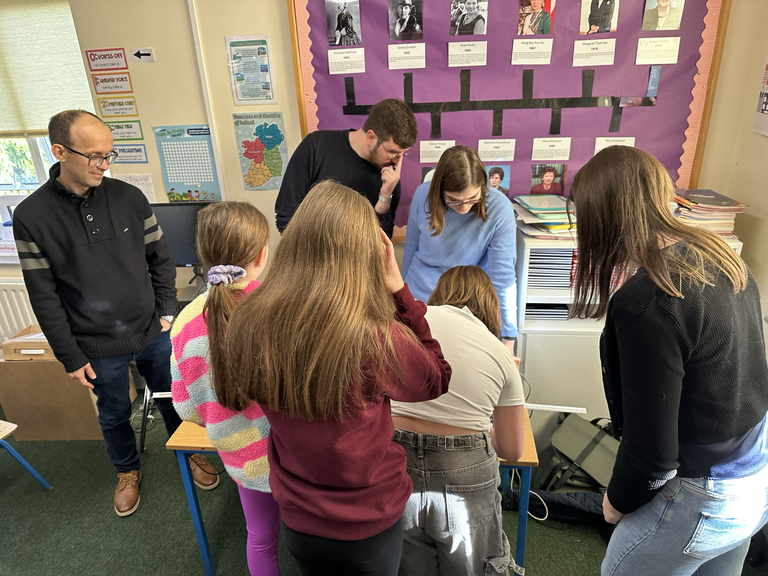
After the conceptualisation and development phases, the two innovative activities were refined to develop and foster numeracy skills and cultivate positive attitudes toward math while introducing children to the foundational concepts of control theory and robotics. These activities were designed to align with the project’s objectives. Activity 1) the Robot Maze Challenge "The Robot Saves the World". This activity introduced students to control theory through a space-themed maze where they guided a humanoid robot using voice commands. The engaging narrative emphasised feedback systems, precise communication, teamwork, and problem-solving. And activity 2) Interactive Number Line Activity: A hands-on exercise designed to improve visuospatial and arithmetic skills. In 2) the students were invited to a two-part exercise using the digital number line spanning from 0 to 100. In part a) the student would estimate the locations of randomly defined integer numbers shown in a screen. After moving the knob of a linear potentiometer to the desired position, a button should be pressed to confirm the answer. In the second half of the activity, b) the student would be shown two integer numbers, and the new task would be to define the position of the two different numbers once again using the sliding potentiometer. Each time the student confirmed his answers, a log was registered in the laptop connected to the electronic number line for posterior analysis.
The first round of activities was carried out in Castleknock National School with 4th and 5th-grade students on the 12th of November 2024. Approximately 58 students took part in the robot maze and number line activities. Students used voice commands to navigate a robot through a maze, fostering their understanding of feedback systems and control theory. The number line activity helped develop numerical reasoning through a hands-on interface that provided real-time feedback. With the electronic number line, 4th and 5th-year students logged 30 and 126 answers, respectively.
Pre and post-activity surveys were applied to help measure the impact of the activities on students’ attitudes toward math and STEM. Results indicated a significant increase in enthusiasm, confidence, and interest in STEM concepts, supporting the effectiveness of the interventions.
The second round of activities was carried out in Maynooth University Open Day event on the 15th of November 2024 as part of Maynooth University’s annual celebration of scientific innovation. This timing allowed the project to engage a broader audience and maximise community involvement. A wider audience, including children, families, and educators, experienced the project during this community science event. The project activities were presented at this annual event, engaging children, families, and educators. The robot maze and number line exercises were showcased as interactive exhibits, highlighting the practical applications of mathematics, control systems, and robotics. The event promoted STEM education to a broad demographic, reinforcing the importance of early engagement in STEM concepts and encouraging families to support such initiatives. Given the large number of visitors and the vast demographic at the event, 408 entries were logged in the electronic number line activity.
As an extension of the proposal for the project, a secondary activity was proposed for a more mature demographic. The concepts of the electronic number line were expanded to create an electronic demonstrator kit for PID control algorithms. The kit's objective was to enable second-year electronic engineering students to apply the concepts demonstrated in lectures in a practical setting. The kit demonstrated PID concepts in a DC motor position control system. Users were invited to experiment with controller gains with interactive knobs to investigate the difference in the dynamic response of the system in closed-loop conditions.
Two conference papers were published with the results obtained from this project. The development and data analysis of the electronic number line activities were published in Maynooth University EDI in Practice in Higher Education Conference (EQUITAS) in June 2025. The electronic PID control position control plant was published in the Irish Signals and Systems Conference (ISSC) 2025.
In conclusion, this project successfully combined innovative STEM activities with targeted engagement strategies to foster numeracy skills, reduce math anxiety, and introduce children to control theory and robotics. The collaboration of engineers (Dr. Ariadne L. J. Bertolin and Matheus Mulherchen Golz Costa) and psychologists (Dr. Flávia H. Santos and Samuel Roberts) ensured a well-rounded approach, blending technical accuracy with psychological insights.
Through outreach at Castleknock School and participation in Maynooth Science Night 2024, the project demonstrated the effectiveness of interactive and playful learning experiences in making STEM concepts accessible and enjoyable. The pre- and post-survey results highlighted the activities’ potential for broader implementation, making a strong case for integrating such interventions into primary education curricula.
These efforts underscore the project’s commitment to inspiring the next generation of problem-solvers and critical thinkers, fostering a lasting interest in STEM fields while building essential numeracy skills.