
2nd IFAC Latin American Women in Control Engineering Meeting
Activity Organizer: Dr. Martha Belem Saldívar Márquez,CINVESTAV Zacatenco, belem.saldivar@cinvestav.mx
IFAC Sponsor: Mexican Association of Automatic Control (AMCA)
The 2nd IFAC Latin American Women in Control Engineering Meeting (2nd IFAC LA-WICE Meeting) was held on October 13, 2025, during the XX Latin American Control Congress in Cancún (LACC 2025), Mexico—an IFAC-x-labeled event organized by the Asociación de México de Control Automático (AMCA), the IFAC National Member Organization in Mexico, and the Instituto Politécnico Nacional.
The event brought together over 30 women from across Latin America, including undergraduate and graduate students, early-career professionals, and senior researchers in the field of automatic control. Talented women from Mexico, Colombia, Ecuador, Peru, Cuba, Costa Rica, Spain, Brazil, and Chile participated, sharing their experiences, projects, and motivations to continue promoting female participation in control engineering. Its main objective was to enhance visibility, foster experience sharing, and strengthen collaborative networks among Latin American women in control engineering, promoting inclusive leadership, collective learning, and community building within this scientific and technological discipline.
The program featured a range of engaging activities designed to promote interaction and dialogue among participants. To open the event, Dr. Belem Saldivar (Cinvestav, Mexico), the main organizer, welcomed attendees with a warm introductory message.
One of the core activities was a panel discussion on experiences and career trajectories, featuring five distinguished researchers:
- Dr. Sabine Mondié, Centro de Investigación y de Estudios Avanzados del Instituto Politécnico Nacional (Mexico)
- Dr. Cristina Verde, Universidad Nacional Autónoma de México (Mexico)
- Dr. Karina Barbosa, Universidad de Santiago de Chile (Chile)
- Dr. Mercedes Chacón, Universidad de Costa Rica (Costa Rica)
- Dr. Doris Sáez, Universidad de Chile (Chile)
The panelists shared insightful reflections on the barriers faced by women in engineering, particularly within the field of automatic control, and discussed the challenges encountered by Latin American women researchers in advancing and excelling in their careers. They also recounted their personal motivations for pursuing control engineering, as well as the strategies, sources of support, and key experiences that shaped their professional paths. An important theme throughout the discussion was the role of mentoring and female support networks in fostering professional growth. The session concluded with a Q&A segment, where participants raised thoughtful questions about topics such as balancing motherhood and academic life and navigating gender-related challenges in a traditionally male-dominated STEM field. The panelists offered inspiring and practical advice to younger attendees at the beginning of their careers.
In addition to the discussion, participants enjoyed several interactive and recreational activities. Among them was the Control Marathon, a friendly competition that allowed female students to demonstrate their knowledge of control theory. The atmosphere was informal and motivating, enabling participants to showcase their skills while also enjoying the camaraderie of their peers. The winners received symbolic keychain souvenirs featuring the event logo.
A participatory workshop on networking, mentoring, and leadership was also conducted. Participants worked in small groups to analyze the types of support currently present in their professional networks, identify areas where support is lacking, and share ideas and strategies for strengthening and expanding these networks within academic and professional environments.
As a closing activity, participants presented their ongoing initiatives and research projects, with the goal of identifying opportunities for collaboration and joint development of research efforts in Latin America.
Throughout the event, attendees had the chance to connect informally over coffee and snacks, fostering a warm and collaborative atmosphere. Participants expressed great enthusiasm and gratitude for the opportunity to engage in such an enriching experience, emphasizing their interest in future editions of the meeting.
The support of IFAC was instrumental in making this event possible. Thanks to its contribution, travel grants of 220 euros were awarded to attendees from Mexico and grants of 500 euros to participants from other parts of Latin America. IFAC’s support also helped cover additional expenses, including banners, appetizers, and souvenirs. Without this support, such a meaningful and successful gathering would not have been achieved. Likewise, AMCA provided additional support by covering accommodation for female students registered for the LACC 2025 and offering a 50% discount on the registration fee, thereby encouraging broader female participation in both the LACC 2025 and the 2nd IFAC LA-WICE Meeting.
The meeting concluded with the presentation of certificates led by Dr. Belem Saldivar, the event organizer, and Dr. Lizeth Torres, President of AMCA. Participants expressed gratitude for the recognition and celebrated the success of a meeting that was both professionally enriching and personally empowering. Many attendees conveyed strong interest in continuing their involvement in future editions of IFAC LA-WICE Meeting and helping expand its impact across the region.
The 2nd IFAC LA-WICE Meeting generated significant results that greatly contributed to strengthening the community of women in automatic control across Latin America. The event reinforced regional networks among researchers and students, fostering solid professional connections. It also enhanced the visibility of Latin American women’s contributions to the field, highlighting their important role in advancing control engineering. The program supported participants’ professional development through the career-focused panel and mentoring-oriented activities, while also encouraging new collaborations emerging from research presentations and peer interaction.
There were no significant deviations from the originally approved application. All planned activities—including the panel, workshops, networking spaces, and research presentations—were carried out as intended. The objectives related to enhancing visibility, promoting collaboration, and strengthening the community were fully achieved. Moreover, the event produced additional positive outcomes, such as expanded networking opportunities and increased participant engagement, exceeding the initial expectations.
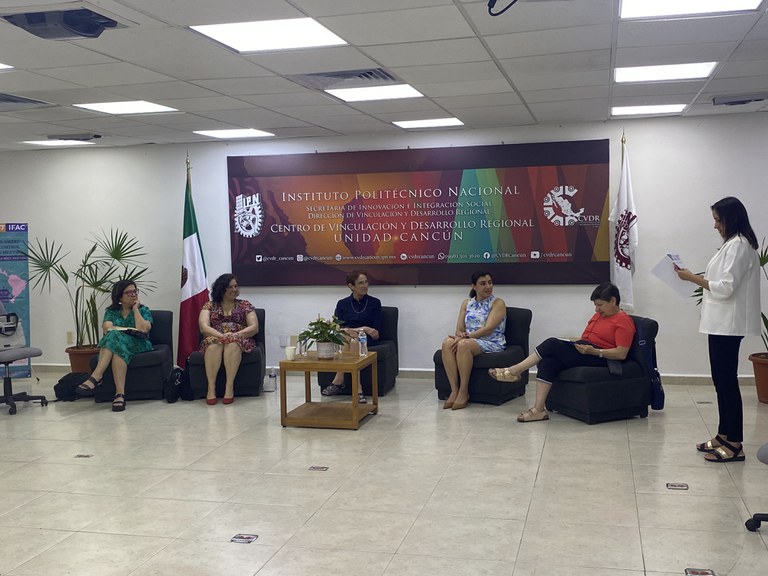
This photograph (above) features the five distinguished panelists whose discussion served as a central pillar of the meeting, offering a rich and candid dialogue on the challenges and opportunities faced by women in automatic control. From left to right: Dr. Doris Sáez (Universidad de Chile, Chile), Dr. Karina Barbosa (Universidad de Santiago de Chile, Chile), Dr. Sabine Mondié (Cinvestav-IPN, Mexico), Dr. Mercedes Chacón (Universidad de Costa Rica, Costa Rica), and Dr. Cristina Verde (Universidad Nacional Autónoma de México, Mexico). Standing at the far right is Dr. Belem Saldivar, the event organizer.
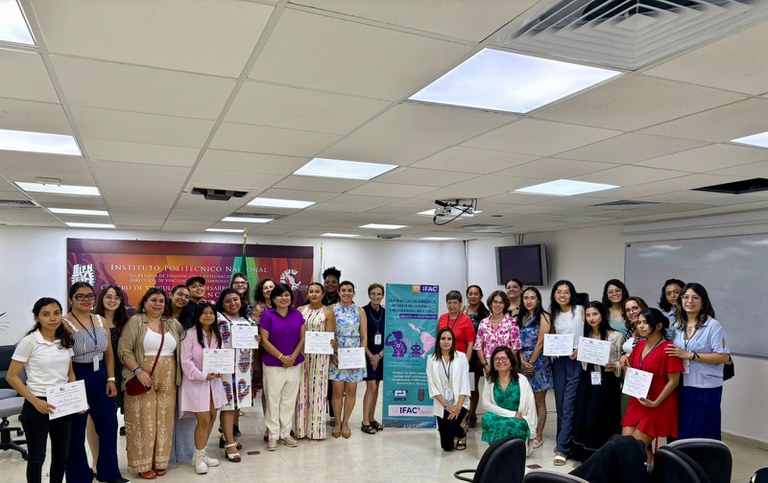
This photograph shows the diverse group of participants who attended the meeting. The group includes undergraduate and graduate students, early-career professionals, and senior researchers from Mexico, Colombia, Ecuador, Peru, Cuba, Costa Rica, Spain, Brazil, and Chile who shared their experiences, research projects, and motivations for promoting greater female participation and leadership in control engineering.