ROV-based treasure hunts for attracting students towards control and robotics
Project Lead: Giulia Michieletto, Assistant Professor, Department of Management and Engineering, University of Padova, Italy; giulia.michieletto@unipd.it
IFAC Sponsors: TC 7.5, Intelligent Autonomous Vehicles; TC 9.2, Systems and Control for Societal Impact.
The two outreach activities carried out within this project focused on introducing students and the general public to robotics and control engineering through interactive demonstrations and hands-on experiences. While the original proposal envisioned organizing a series of remotely operated vehicle (ROV)-based treasure-hunt events in different locations, the implemented activities pursued the same outreach objectives through participation in two large public initiatives organized in collaboration with local institutions and the University of Padova. These initiatives allowed us to reach a diverse audience of students across multiple age groups and to present robotics technologies in realistic application contexts.
Activity1" Participation in “Port Days” – Chioggia
The first activity took place within the Port Days event organized in the city of Chioggia. The initiative was primarily targeted at high-school students (around 50 participants) and aimed at presenting the concept of “ports of the future,” highlighting how technological innovation is transforming maritime infrastructures.
Within this framework, our team prepared an introductory presentation illustrating the role of robotics and autonomous systems in modern port environments. The presentation focused on several key aspects, including underwater inspection, infrastructure monitoring, environmental assessment, and autonomous navigation technologies. Particular emphasis was placed on explaining how robotics and control engineering contribute to improving safety, efficiency, and sustainability in port operations.
Following the introductory session, we proposed hands-on demonstrations involving both underwater and surface robotic platforms. Students were introduced to remotely operated vehicles (ROVs) and small autonomous surface vessels and were guided through the basic principles governing their operation, including sensing, control, and teleoperation.
Participants had the opportunity to interact directly with the robotic systems and observe how such platforms can be used to investigate the condition of port infrastructures. The demonstrations simulated inspection activities typically required in maritime environments, such as monitoring underwater structures, assessing the state of the seabed, and observing the conditions of docks and quay walls. By connecting the demonstrations to real operational scenarios, the activity helped students understand the practical impact of robotics technologies in maritime engineering.
The event provided an effective platform for engaging students who may not normally encounter robotics in their school curriculum. Through the combination of presentation and practical demonstrations, participants gained insight into how research in robotics and control translates into real-world applications within critical infrastructures.
Activity 2: “Science4All” – Roboavventura: sperimenta, scopri e stupisciti
The second activity was organized within the Science4All program supported by the University of Padova. This initiative aims to promote scientific culture and curiosity among younger students through interactive educational laboratories.
Within this program, we organized a laboratory titled “Roboavventura: sperimenta, scopri e stupisciti”, targeted at students attending the fourth and fifth grades of primary school (around 100 participants in total). The laboratory was designed as a structured educational experience composed of three main phases, allowing students to explore the world of robotics progressively.
Introductory phase: The laboratory began with a short and accessible introduction to robots and their role in everyday life. Using simple examples and visual material, we presented the basic idea of a robot as a system capable of perceiving the environment, making decisions, and acting through motors or other actuators. The discussion included examples from different application domains, such as industrial robotics, exploration robots, marine robotics, and service robots. The goal of this initial phase was to stimulate curiosity and provide students with a broad overview of how robotics technologies are used in society.
Hands-on construction activity: The central part of the laboratory consisted of a collaborative construction activity. Students were divided into small groups and provided with educational robotic kits that allowed them to assemble simple robotic platforms. Depending on the kit used, the students built small ground or marine robots. This phase emphasized teamwork, experimentation, and problem-solving. Students actively participated in the assembly process and tested the robots they constructed, observing how changes in configuration affected the robot’s behavior. The activity encouraged exploration and creativity while simultaneously introducing basic concepts related to sensing, actuation, and control.
Research demonstration phase: The final part of the laboratory connected the educational activities with current research carried out in our laboratory on autonomous robotics. Through videos, demonstrations, and informal discussion, students were shown examples of real robotic systems developed for tasks such as autonomous navigation, environmental monitoring, and aerial or marine exploration. This concluding phase served two main purposes. First, it allowed students to see how the simple concepts they explored during the hands-on activity relate to advanced research systems. Second, it provided an opportunity to present robotics as an exciting field of study and research, potentially inspiring future interest in STEM disciplines.
Outcomes and impact
Overall, the activities successfully engaged students across a broad age range, from primary school pupils to high-school students. By adapting the format and level of explanation to different audiences, we were able to communicate the key ideas underlying robotics and control engineering in an accessible and engaging manner.
A central aspect of both initiatives was the emphasis on interactive participation. Rather than presenting robotics only through lectures or demonstrations, participants were encouraged to directly interact with robotic systems, experiment with them, and ask questions. This approach proved effective in stimulating curiosity and maintaining engagement.
Another important outcome was the opportunity to connect scientific research with real-world applications. In the Port Days event, robotics was presented in the context of maritime infrastructures and port monitoring, demonstrating its relevance for future technological developments. In the Science4All laboratory, students were able to see how the basic mechanisms of sensors, actuators, and control they explored during the activity scale up to complex robotic systems used in current research.
Deviations from the original plan
The original proposal envisioned organizing a series of treasure-hunt activities based on underwater remotely operated vehicles operating in public water environments. While this format remains a promising approach for public engagement, the activities implemented during the project took a partially different form.
Instead of organizing standalone treasure-hunt events, we integrated our outreach activities within larger public initiatives already established by local institutions and the university. This choice allowed us to reach a broader and more diverse audience while benefiting from the organizational infrastructure provided by these events.
Although the treasure-hunt format was not implemented in its original form, the core objectives of the project remained unchanged. In particular, the activities continued to focus on:
- introducing participants to robotics and control engineering,
- providing hands-on interaction with robotic systems,
- highlighting real-world applications of robotics technologies,
- promoting interest in STEM disciplines among younger generations.
Furthermore, the demonstrations involving underwater and surface robots during the Port Days event preserved the spirit of the original concept by allowing participants to explore maritime environments using robotic platforms.
Concluding remarks
The outreach initiatives conducted within this project successfully promoted robotics and control engineering among a wide audience of students. Through a combination of presentations, demonstrations, and hands-on laboratories, participants were introduced to the principles underlying robotic systems and their practical applications. The experience gained during these activities will also inform future outreach initiatives. In particular, the positive response from participants suggests that interactive demonstrations and educational laboratories represent effective tools for communicating robotics research to non-specialist audiences.
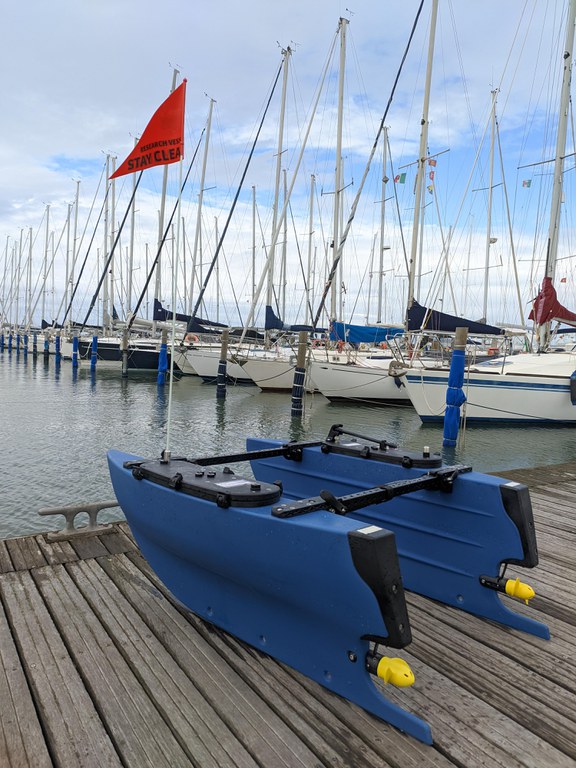
The UNIPD BlueBoat uncrewed surface vessel employed for hydrographic surveying of the Chioggia harbor basin during the Port Days event. The platform was demonstrated to high-school students as an example of autonomous surface technology applied to maritime infrastructure monitoring.
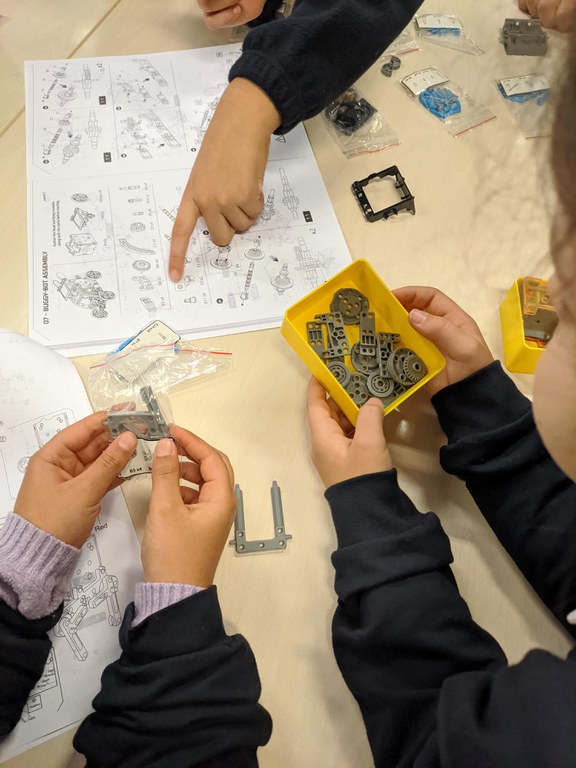
Primary school students engaged in the hands-on construction activity during the Roboavventura laboratory, part of the Science4All program. Working in small groups, participants assembled simple robotic platforms using educational kits, exploring basic concepts of sensing, actuation, and control.